

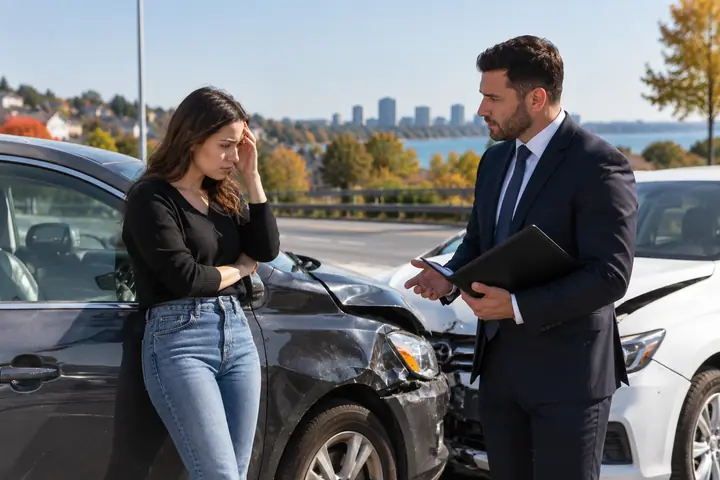
Injured in a Car Accident in Pickering?
A car accident in Pickering - on Highway 401, Kingston Road, or near Pickering Town Centre - brings insurance calls, medical appointments, and decisions that can't wait. ontario-car-accident-lawyer.ca isn't a law firm.
It's a free, no-obligation service connecting people injured in Pickering and across Durham Region with independent lawyers licensed by the Law Society of Ontario. A Pickering personal injury lawyer from the network can help you understand what applies to your specific situation.
How Our Matching Service Works
Getting matched with a lawyer through this service is meant to feel like a conversation, not a form to fill out and forget. Each step below builds on the last, and nothing moves forward without your say-so.
Tell Us What Happened
Share a short description of the accident - when it happened, where in Pickering it occurred, what injuries you sustained, and what questions you have. The details help match you with a lawyer whose practice fits your situation.
The more specific you can be, the better the match tends to be. A rear-end collision on Highway 401 with a soft-tissue injury calls for a different kind of experience than a pedestrian accident near Pickering Town Centre with a fracture, even though both fall under the same general framework.
We Match You With a Lawyer From Our Pickering-Area Network
We connect you with an independent lawyer licensed by the Law Society of Ontario who handles motor vehicle and personal injury claims in the Pickering area and across Durham Region. Every lawyer is vetted for current licensing status and practice area focus.
This vetting isn't a one-time check performed years ago and forgotten. Licensing status and practice focus are the baseline criteria used before any lawyer is added to the network, and the goal is matching you with someone whose day-to-day practice actually involves cases like yours, not a general practitioner handling it as a side matter.
Speak Directly With the Lawyer: Free, No Obligation
The initial consultation is free. You speak directly with the lawyer - not a screener - and get specific answers about your situation. There's no cost and no commitment involved.
This conversation is where you can ask about anything covered on this page in more detail - the SABS changes, the serious-and-permanent threshold, whether a Minor Injury Guideline classification on your file seems accurate, or what your specific limitation deadline looks like given the facts of your accident.
Decide How to Move Forward
There's no pressure. You decide whether to retain the lawyer, seek a second opinion, or handle things yourself. The matching service costs nothing to use either way.
Some people use this step to compare two or three lawyers before deciding. Others move forward after a single conversation because the fit feels right. Either approach is fine - the point of the free consultation is to give you enough information to make that call comfortably.
What Happens After a Car Accident in Ontario
A personal injury claim in Pickering, Ontario generally follows the same provincial framework, whether the collision happened on Brock Road, Bayly Street, or Whites Road.
This framework covers everyone injured on a Pickering road, regardless of whether they were driving, a passenger, a cyclist, or a pedestrian at the time. The steps below apply broadly across that framework, though the specific benefits and deadlines that end up mattering most depend heavily on the details of what happened.
Reporting requirements, medical documentation, and insurer notifications all tend to have their own timelines running in parallel, and missing one doesn't necessarily disqualify a claim but can make it harder to support later on.
Report the Accident and Seek Medical Attention
After a collision in Pickering, two things matter most in the first 48 hours: reporting it properly and getting checked out medically - even if you feel fine. Here's a quick reference:
| Step | What to Do | Why It Matters |
|---|---|---|
| Report the collision | File at a Collision Reporting Centre within 48 hours if combined damage exceeds $5,000 (Durham Regional Police rule) | Required by police policy; creates an official record for insurance |
| Get medical attention | Visit Ajax Pickering Hospital or another Lakeridge Health facility same-day or next-day, even without obvious injuries | Whiplash and concussion often show no symptoms right away - an early record closes the documentation gap |
| Track your recovery | Log follow-up appointments, changing symptoms, and impact on daily activities | Builds a clear timeline that's far more credible than reconstructing events from memory months later |
Skipping the early medical visit is the most common mistake - it leaves a gap an insurer can later use to question whether the injury was really caused by the accident. A same-day check-up, followed by simple ongoing notes, gives both you and any lawyer you work with a much stronger foundation for the claim.
The 48-hour reporting window, in particular, is worth taking seriously even when a collision seems minor at first glance. Vehicle damage that looks superficial can sometimes exceed the $5,000 threshold once a repair estimate comes in, which means the reporting obligation can apply even to accidents that didn't feel serious in the moment.
Statutory Accident Benefits (SABS): Available Regardless of Fault
SABS benefits give injured drivers a safety net that doesn't depend on who was at fault.
- Available through your own insurer, regardless of who caused the accident
- No-fault: covers medical, rehabilitation, and related costs either way
- No need to wait for a fault determination to access support
- Claims move through your own insurer independently of the fault investigation
- Treatment and rehab generally continue even while fault is still disputed
This means that even in a disputed or unclear accident, you can start getting medical and rehabilitation support right away, without waiting on the outcome of a fault investigation.
That independence between accident benefits and fault determination is one of the more reassuring parts of Ontario's system for people dealing with an accident where responsibility isn't immediately clear.
What Changed With SABS Coverage in 2026

For auto policies issued or renewed on or after July 1, 2026, medical, rehabilitation, and attendant care benefits remain mandatory.
Income replacement, non-earner, caregiver, housekeeping, death and funeral, visitor expenses, education expenses, and clothing or personal-item benefits may now be optional depending on the specific policy - worth checking your own coverage rather than assuming it's included.
This is a meaningful shift from how the benefit schedule worked before this reform. A policy renewed just before July 1, 2026 may carry different coverage than one renewed just after, even for the same driver with the same insurer - which is exactly why confirming your own policy's specific terms matters more now than it used to.
For anyone unsure which side of that line their policy falls on, checking the renewal date against July 1, 2026 is the fastest way to know which version of the benefit schedule applies. The lawyer you're matched with can help interpret what that means once you know the specific date.
When a Tort Claim Against the At-Fault Driver May Apply
If another driver was responsible, a tort claim may cover damages SABS doesn't reach - pain and suffering, income loss beyond SABS limits. A tort claim for pain and suffering requires meeting a "serious and permanent" impairment threshold, and it has its own limitation period under Ontario's Limitations Act, generally 2 years from the date of the accident.
Meeting that threshold isn't automatic - it depends on medical evidence showing the impairment is both serious and expected to be permanent, which is why documentation from early on in the recovery process tends to matter so much later in a tort claim.
Two years might sound like plenty of time, but that clock generally starts running from the date of the accident, not from when someone gets around to consulting a lawyer. Waiting too long to explore this option can mean losing the ability to pursue it at all, regardless of how strong the underlying claim might otherwise have been.
Your Options After a Pickering Car Accident
People hurt in a car accident in Pickering typically have access to a few compensation routes:
- Accident Benefits Claim (No-Fault) - through your own insurer, regardless of fault
- Tort / Liability Claim - against the at-fault driver, for damages SABS doesn't cover, subject to the serious-and-permanent threshold
- Small Claims Court - for lower-value disputes or property-only claims
Accident Benefits Claim (No-Fault)

This claim goes through your own insurer and doesn't require proving fault. It's typically the fastest route to medical and rehabilitation support, and it's available even before fault has been determined.
Because it doesn't hinge on fault, this is usually the first claim to get moving after an accident, even when the tort question remains unresolved or contested between insurers.
Tort / Liability Claim
A tort claim against the at-fault driver requires meeting the serious-and-permanent impairment threshold for pain and suffering damages. Insurers use Ontario's Fault Determination Rules to assign fault percentages, which is a separate process from any police charges.
It's worth noting that a police charge, or the absence of one, doesn't determine fault for insurance purposes. An insurer's Fault Determination Rules assessment runs independently, which means someone can face no criminal charges and still be found substantially at fault under the insurance framework, or vice versa.
Small Claims Court (lower-value or property-only claims)
For disputes involving lower amounts or property damage only, Small Claims Court can be an option outside the standard insurance claims process.
This route tends to suit situations where the dispute is narrow and well-defined - a disagreement over a repair estimate, for example - rather than a broader personal injury claim involving ongoing medical treatment.
What Can Affect the Time and Value of a Claim
No accurate figure applies universally to any car accident claim. Severity and documentation of injury, whether the threshold test is met, insurer cooperation, and whether the Minor Injury Guideline (MIG) has been applied to your file can all affect the outcome - and MIG classification can be contested if it was wrongly applied.
Insurer cooperation in particular can shift the timeline substantially. A straightforward claim with no fault dispute and clear medical documentation can move relatively quickly, while a contested MIG classification or a disputed fault percentage can extend a claim well beyond what either side initially expected.
Documentation quality plays a similar role. A claim supported by consistent medical records, a clear timeline of symptoms, and receipts for related expenses tends to move more predictably than one where records are sparse or inconsistent.
Car Accident Lawyers Near Pickering
If the collision happened closer to a neighbouring city, the network also matches people with lawyers in nearby areas: car accident lawyer in Ajax, car accident lawyer in Scarborough and car accident lawyer in Whitby. Every other city is listed on the locations page.
Why Use ontario-car-accident-lawyer.ca to Find a Pickering Car Accident Lawyer
A Vetted Network of Ontario Lawyers
Every lawyer in the network is independently licensed by the Law Society of Ontario and focuses on motor vehicle and personal injury claims. Lawyers serving Pickering through this network handle these cases as a primary practice area.
That focus matters more than it might seem. A lawyer who handles motor vehicle and personal injury claims regularly develops a working familiarity with how local insurers, adjusters, and even specific Collision Reporting Centres tend to operate - familiarity that a general practice lawyer taking the occasional case simply doesn't build up in the same way.
Free to Use, No Obligation
There's no cost to use the matching service, and consultations with lawyers in the network are typically free. If you retain a lawyer, many work on a contingency-fee basis, with specific terms confirmed directly with the lawyer before any work begins.
Nothing about using this service commits you to hiring anyone. You can go through the matching process, have the consultation, and still decide to handle things independently or look elsewhere - the service itself never charges you regardless of which path you choose.
Fast Matching: No Guesswork
Most users looking for a Pickering car accident lawyer are matched within one business day. If a limitation period or other deadline is approaching, flag it in the intake form and the match is treated as urgent.
Flagging an approaching deadline isn't just a formality - it changes how quickly the match happens. A situation where a limitation period is close to expiring gets prioritized differently than a general inquiry with no immediate time pressure.
About This Page
Reviewed for Accuracy: This page is reviewed periodically by the editorial team at ontario-car-accident-lawyer.ca and checked against current Ontario insurance legislation, including SABS regulations and the Limitations Act. Content is updated as regulations change.
Regulations affecting SABS benefits and reporting thresholds don't stay static, and a page like this one is only useful if it reflects the current rules rather than an outdated version of them. That's the purpose of this review process - keeping the information here aligned with what's actually in effect.
We Are Not a Law Firm
ontario-car-accident-lawyer.ca is a lawyer-matching service, not a law firm. It does not provide legal advice, legal opinions, or legal representation. Nothing on this page constitutes legal advice for any specific situation.
How We're Compensated
ontario-car-accident-lawyer.ca is free for injured people to use. The portal may receive a referral fee from lawyers in the network when a match results in a client relationship. This fee is paid by the lawyer, not by you, and does not affect the amount of any settlement or award, the fees the lawyer charges you, or which lawyer you're matched with.
This structure is worth being upfront about. The fee arrangement exists between the portal and the lawyer, entirely separate from anything you pay or receive - it doesn't change what a lawyer charges you, and it doesn't influence which lawyer gets matched to your specific situation.